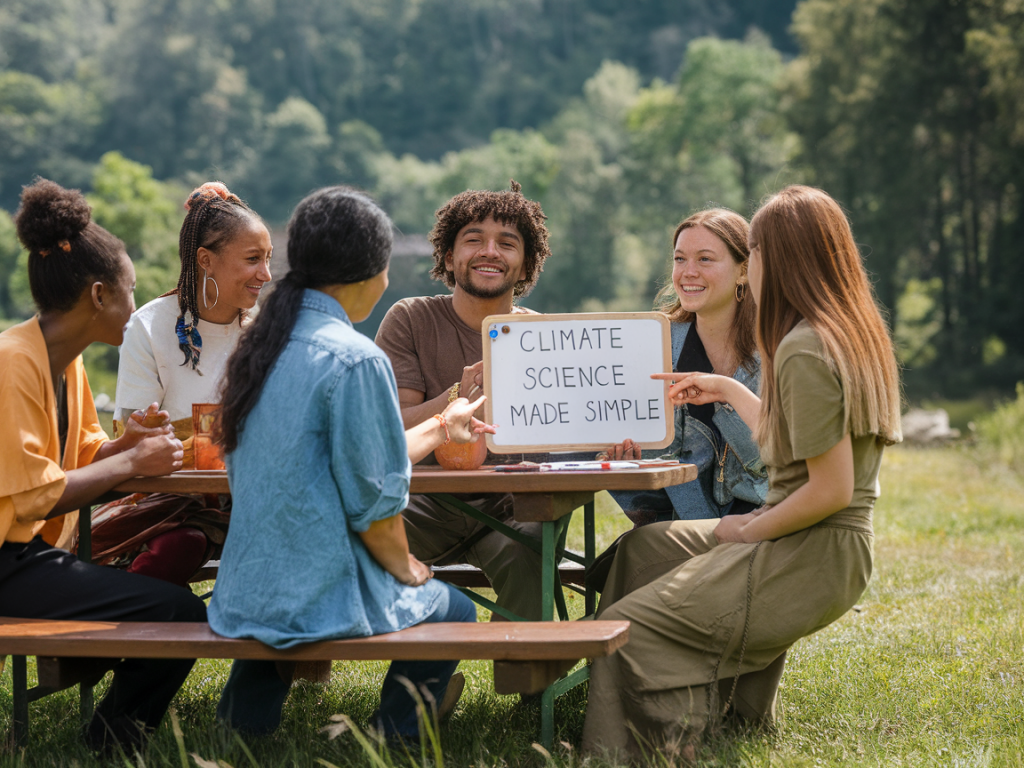
I have lost count of the number of times a conversation about the weather has slid, almost imperceptibly, into a debate about climate change. Those moments have taught me more about listening than about lecturing. If you want to explain climate science to friends without starting an argument, the trick isn’t to have the sharpest facts — it’s to be deliberate about how you enter the conversation, how you frame the evidence, and how you respect the relationship more than you demand agreement.
Start with curiosity, not correction
When someone says, “It wasn’t this hot when I was young,” my first impulse isn’t to produce charts. I ask questions: “When and where do you remember it being different?” or “That’s interesting — what do you remember about summers back then?” Questions do two things. They slow the conversation and they signal respect. People are far less defensive when they feel heard. You can collect details that reveal whether the person is talking about local memory, a particular extreme event, or a broader belief about climate and policy.
Tell stories, then layers of explanation
Climate science is a web of data, models, and mechanisms. An abstract explanation about radiative forcing or greenhouse gas concentrations will land better if it follows a small, human story. I often begin with a concrete thread — a recent heatwave, a flooded market, or even a gardening season that changed — then expand into why scientists connect those events to global trends.
For example: “Remember that summer when the river flooded the market? Scientists look at patterns of heavy precipitation and compare them to long-term records. They also run models to see how warming changes the odds of such floods. It’s like saying a loaded die rolls six more often — we can’t say any single roll is caused by the loading, but the chance of rolling six increases.”
Use simple analogies — carefully
Analogies are the scaffolding of understanding. I use them, but I try to keep them honest. The “loaded die” analogy above helps explain probabilistic attribution. The “blanket around the Earth” works for greenhouse gases, but I’m careful not to overextend it. A useful analogy gains understanding; a stretched one creates misconceptions.
Lead with observable facts, not distant projections
People respond to the immediate and local. Mention observable trends near them: earlier springs, longer summers, or species shifts in local parks. Those observations are often easier to connect to than abstract projections for 2100. Once we agree on recent changes, it’s easier to talk about how scientists use those observations alongside models to make future projections.
Explain uncertainty as a feature, not a flaw
One reason climate conversations devolve is the misuse of uncertainty. I’ve learned to reframe uncertainty as useful: “Science doesn’t pretend to know everything; it measures the range of possibilities and says what is likely, unlikely, and unknown. For heatwaves, scientists can be very confident that warming increases both the intensity and frequency.”
Share how science actually works — and why consensus matters
People often distrust “consensus” because they picture scientists as a closed club. I explain consensus as the result of independent lines of evidence converging: ice cores, satellite data, ocean heat measurements, tree rings, and physics-based models all point the same way. It’s not agreement by authority; it’s agreement because very different methods tell a consistent story.
Use simple visuals when possible
I’ll sometimes show a graph — but chosen carefully. The Keeling Curve (atmospheric CO2 rising) or a simple global temperature anomaly plot can be surprisingly persuasive if you explain axes and scale. If you can’t show a chart, describe what it would look like: “If you plotted average global temperature over a century, you’d see a clear upward trend, and the last few decades stand out.”
Keep myths in one hand and the real explanation in the other
Myth-busting can be tempting, but repeating a false claim can entrench it. If a friend brings up “climate models are unreliable,” I might say: “It’s true models aren’t perfect — they don’t aim to be. Instead, they’re tools that have successfully predicted many large-scale patterns, like warming from greenhouse gases and changes in rainfall patterns. We test them against past climate and observations to see where they succeed and where they need improvement.”
Offer practical, non-judgmental steps
Conversations get less argumentative when they’re paired with practical options. Instead of pushing for dramatic lifestyle changes, I suggest approachable ideas: trying a plant-forward meal once a week, checking if your electricity supplier has a green tariff, installing a smart thermostat, or supporting local tree-planting groups. These are tangible, not political, and they give people a sense of agency.
Recognize values and listen for them
People’s responses to climate information often reflect deeper values — worry about the economy, distrust of experts, or concern for future generations. I listen for underlying values and address them directly. If someone fears economic harm from climate action, I will talk about job opportunities in renewable energy, energy efficiency savings, and examples of communities that have transitioned successfully.
Be ready to admit what you don’t know
Admitting gaps in your knowledge builds credibility. If someone asks a technical question I can’t answer, I’ll say so and offer to look into it. I might point them to accessible resources I trust: the IPCC summaries for policymakers, NOAA or Met Office explainers, or concise explainers from scientific organizations. On my site, Chancerne Co (https://www.chancerne.co.uk), I try to collect clear, practical explainers that people can read later without feeling overwhelmed.
Use empathy as a rhetorical tool
Empathy isn’t about agreeing on everything — it’s about acknowledging feelings. If a friend is anxious about climate news, I’ll say, “I get why that would feel heavy.” If someone is skeptical, I’ll say, “I used to wonder the same thing.” Those small acknowledgements defuse defensiveness and make space for dialogue.
Know when to step back
Not every conversation needs to be won. Sometimes the best move is planting a seed: share a short article, suggest a documentary, or invite someone to a local talk. Change often happens slowly. My goal is rarely conversion in one sitting; it’s to leave a conversation respectful, informative, and open to future discussion.
| Approach | Why it helps |
|---|---|
| Ask questions | Reduces defensiveness; reveals what the person truly means |
| Use local examples | Makes abstract trends tangible |
| Explain uncertainty well | Builds trust in scientific methods |
| Offer small, practical steps | Gives agency and avoids moralizing |
These methods aren’t magic, but they’ve made my conversations about climate less combative and more generative. If you want, I can share short scripts for particular moments — someone who says “storms have always happened” or a family member anxious about changes to their hometown. Small tools and a steady tone often do the heavy lifting. Conversations that begin with care have a way of staying friendly, even when the subject matter is urgent.