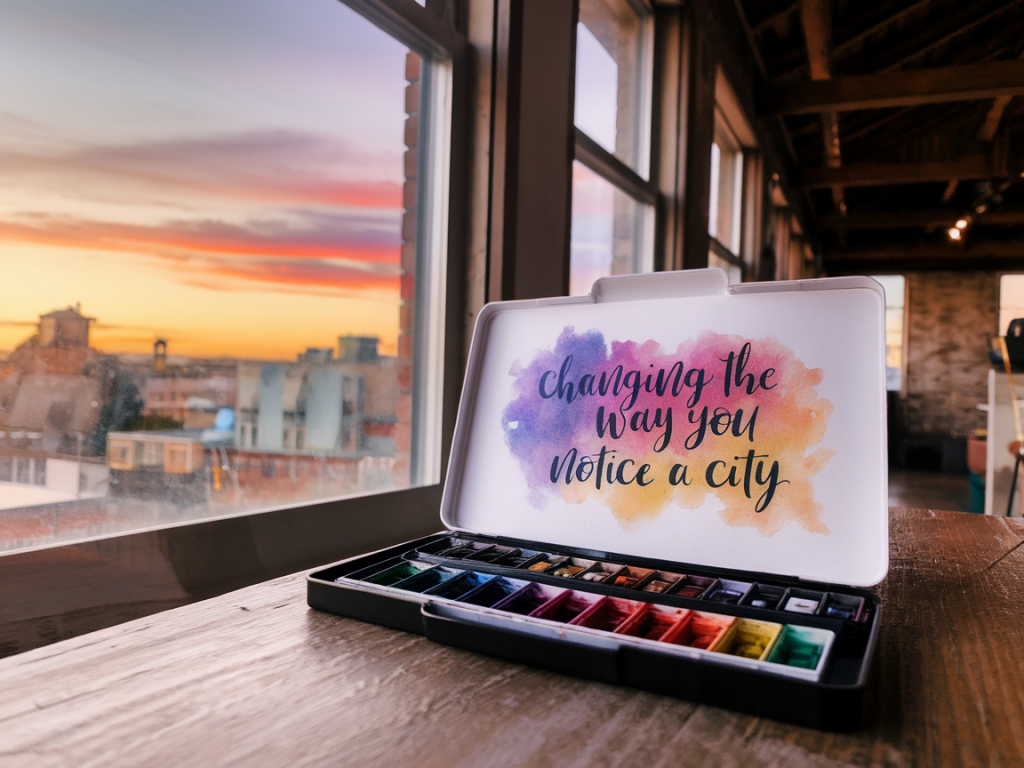
I arrived in the city with a small bag, a cheap travel toothbrush, and a metal tin of watercolors I’d bought on a whim. The tin had twelve half-pans, a tiny brush with a bent ferrule, and instructions in a language I didn’t speak. I expected the usual: a pleasant distraction, a way to mark a weekend away. What I didn’t expect was how quickly the act of painting—brief washes on torn paper in the corner of a café or on the low wall of a canal—would recalibrate the way I looked at streets, faces, and light.
Why a watercolor set feels like a different kind of camera
Photography and sketching are both ways of noticing, but watercolor forces a kind of slow seeing that a camera rarely requires. When I lift a brush I must choose: what to include, what to leave out, what little detail will communicate a scene. The materials themselves—transparent pigment, the bleed of water, paper textures—demand patience. You can’t freeze a moment; you suggest it. That suggestion is a practice of attention.
For a weekend, that attention changes several things. Streets that once felt like background noise become compositional choices: a lamppost becomes a vertical anchor, a puddle offers a sky-reflection, a bus’s chipped paint suggests a color palette. People stop being anonymous shapes and become gestures—a slouched shoulder, the arc of a scarf—details easy to miss when you hurry past.
Practical rituals for a watercolor weekend
On my second day I developed a tiny ritual that shaped the rest of the trip. It’s simple, and you can do it with anything from a Koi Pocket Field Sketch Kit to a slightly nicer Winsor & Newton Cotman half-pan set.
These constraints transform a vague intention—“I’ll paint something today”—into a concrete, manageable practice. They also create a permission to fail. Watercolor rewards experimentation, and failures often lead to unexpected discoveries: a blended color that explains a façade better than a literal match, a smear that reads as a crowd.
What you notice when you have to mix color
Mixing color is a secret teacher. When I mixed a muted violet to describe a shadow under an awning, I understood the awning more deeply than if I’d photographed it. Color mixing forces you to break a scene into temperature, value, and saturation. Instead of saying “that brick is red,” you notice whether it leans orange or toward brown, whether it’s warm against a cool sky or cool because of reflected light. Those are perceptual distinctions that stick.
That lesson carries beyond painting. After that weekend, I found myself more sensitive to the subtle temperature shifts in a city’s light: the way noon light makes a square look flat, while late afternoon brings long, warm shadows that clarify form. I started noticing how certain storefronts used color to suggest a mood—deep green doors that felt quietly confident, pastel shutters that read as invitation.
Small social shifts: how painting invites conversation
Painting outside is a gentle social experiment. People approach differently than they do when you have a camera. A brush and a sketchbook signal intent and craft; they invite curiosity rather than the instantaneous click of a smartphone. In one market I sat on a low stool to capture a vendor arranging oranges. A child came and traced the rim of my paint tin. The vendor paused to show me how he cut his produce—an unexpected exchange that a hurried tourist might never have had.
Those interactions alter the texture of travel. You aren’t just consuming sights; you’re participating in small, local rhythms. A conversation about pigment can become a conversation about place: how the sun behaves here, where to find a good cup of tea, or why a neighborhood smells of diesel and jasmine at once.
Exercises to try on your first painting walk
Quick gear notes (because worth mentioning)
| Item | Why it helps | Portable picks |
|---|---|---|
| Watercolor set | Compact, refillable palettes with good pans save space | Kuretake Gansai, Winsor & Newton Cotman, Sakura Koi |
| Paper | Thicker paper tolerates washes; textured paper adds character | Moleskine Watercolor Album, Stillman & Birn Beta, Arches cold-press sheets (cut to size) |
| Brush | A single good round brush covers most needs | Da Vinci Maestro, Princeton Neptune travel brush, Escoda Reserva travel brush |
What a weekend can change in the long run
After a weekend of painting, the city stays different. You begin to carry a painter’s shorthand in your head: value, edge, temperature. That shorthand helps you remember a place more vividly than photos sometimes do. You also develop a slower habit of attention that benefits non-painting life—shopping, walking, listening. The world becomes a series of little problems to be solved creatively, rather than a blur of images to check off.
People often ask whether you need skill to benefit from this. You don’t. The value isn’t in producing a masterpiece; it’s in using watercolor as a tool to notice differently. Even bad sketches are useful—they show what you overlooked, what you assumed, what surprised you. Over time those surprises teach you to look for them on purpose.
So pack a small tin, a decent brush, and a notebook. Spend a weekend making marks, messing up washes, and talking to strangers who are curious about what you’re doing. You’ll probably come back with a few crumpled pages, a couple of paint-stained fingers, and the subtle sense that the city has become a little more intimate—its colors, its rhythms, and its small revelations waiting every time you look up.